Rockbridge: The Hidden Laboratory of American Conservative Power
Everyone talks about Donald Trump, J.D. Vance, or Peter Thiel. The media are saturated with analyses of the New York billionaire's latest outburst, the meteoric rise of the author of Hillbilly Elegy who became Ohio senator, or the political investments of PayPal's co-founder. But few voices rise to mention Rockbridge, a discreet, elusive structure that could prove far more decisive than the political spectacle we're accustomed to. And this silence is precisely what its members seek.
 A club of influence or a real stranglehold on political power?
A private political club rather than a party
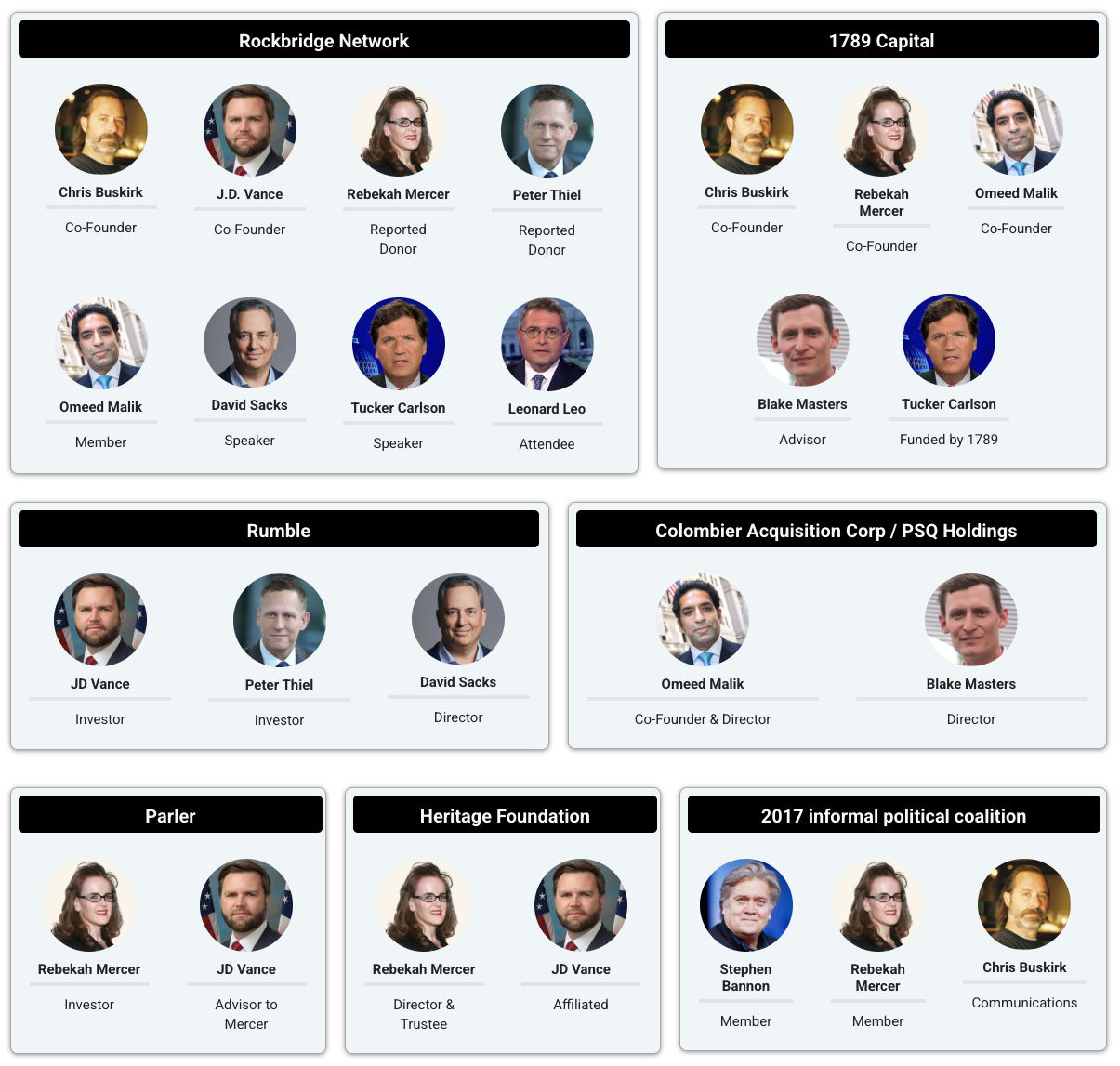
Contrary to appearances, Rockbridge is not a foundation, nor a think tank, nor an organization officially registered as a political entity. It's rather a private club for billionaires and tech entrepreneurs, operating on the Silicon Valley startup incubator model. The entry ticket varies between $100,000 and $1 million per year. What members buy is not a product or a turnkey program, but a seat at the table where the future of the American right is being drawn.
Created in 2019 by J.D. Vance (now Republican senator from Ohio and Donald Trump's running mate in 2024) and Chris Buskirk (conservative editorialist and media entrepreneur), Rockbridge has become a hub where investors, ideologues and strategists meet. The major funders – Peter Thiel, the Mercer family (known for having financed Cambridge Analytica), or the Winklevoss twins (crypto-finance figures) – compose a typical coalition: technology libertarians, hedge fund magnates obsessed with taxation, and cultural warriors on a crusade against progressivism.
A discreet but formidable political infrastructure
If Rockbridge escapes attention, it's because it doesn't just finance flashy presidential campaigns. Its investments target political infrastructure in the broad sense:
-
Media and influence Rockbridge channels funds toward media platforms, podcasts, newsletters and online influencers, so that conservative narratives saturate information flows and redefine the public agenda. The objective is not just to "respond" to opposing arguments, but to occupy the collective mental space.
-
Parallel transition teams The group finances "shadow" transition teams, prepared ahead of elections. When Republicans win power, these armies of experts, lawyers and consultants instantly deploy to Washington to fill key administration positions. A mechanism reminiscent of the Federalist Society's strategy with judicial nominations.
-
Judicial strategy Rockbridge invests in strategic litigation: lawsuits against universities, media or institutions deemed "woke." The goal is to use law not only as a shield, but as an offensive weapon, shaping jurisprudence favorable to conservatives.
-
Local control The organization knows that power isn't limited to the White House. It supports local elections: sheriffs, judges, school boards. The bet is clear: lock down institutions at the base to shape the country from the bottom up, following the Tea Party strategy of the 2010s.
Why Rockbridge matters more than Trump
Donald Trump, in this perspective, is just a media circus figure. Rockbridge doesn't attach itself to a political personality, but builds a lasting machine, capable of surviving the alternation of candidates. Whether it's Trump, Ron DeSantis, J.D. Vance or another rising figure, it doesn't matter: the structure is designed to function as a self-supporting political infrastructure, fueled by private money and coordinated through biannual retreats in discreet locations – Palm Beach, Washington, sometimes even abroad.
From these meetings emerge campaigns, lawsuits, political narratives that will appear in public debate six months later. In other words: what we see on the surface of the political game is often just the result of strategies prepared upstream by Rockbridge and its equivalents.
A strategy in continuity with the radical right
The Rockbridge method doesn't appear ex nihilo. It fits into a long tradition of building parallel conservative networks, begun in the 1970s with the Heritage Foundation and perfected with the Federalist Society. Rockbridge's innovation lies in its hybridization with startup culture and its ability to merge technological money, cultural populism and institutional engineering.
The risks for American democracy
This type of structure raises several questions:
- Opacity and accountability: Since Rockbridge is not an official entity, it escapes transparency rules imposed on parties and PACs.
- Concentration of influence: by financing judicial and media battles, a handful of billionaires can durably orient the framework of public debate.
- Institutional erosion: by massively investing in local elections and attacking the university system, Rockbridge weakens checks and balances.
A future already in preparation
While most observers remain hypnotized by Trump's figure, Rockbridge is implementing the conservative roadmap for the next twenty years. An underground, organized machine that seeks to profoundly reshape American culture, law and institutions. Ignoring Rockbridge means risking debating only the political spectacle, without seeing the discreet engineering that's already shaping the future.
Sources and supplementary reading
- Jane Mayer, Dark Money: The Hidden History of the Billionaires Behind the Rise of the Radical Right, Doubleday, 2016.
- Nancy MacLean, Democracy in Chains: The Deep History of the Radical Right's Stealth Plan for America, Viking, 2017.
- David A. Graham, The Fakest Populism You Ever Saw, The Atlantic 2024.
- Max Chafkin, The Contrarian: Peter Thiel and Silicon Valley's Pursuit of Power, Penguin, 2021.
- The Heritage Foundation, Mandate for Leadership (successive reports since 1980, used as transition models by Republicans).
- Investigative articles from ProPublica 1 2 and the New York Times 1 2 on opaque political financing and Republican donor networks.
- Studies from OpenSecrets.org on PACs, Super PACs and "dark money" in the American system.