Record fine against X: Elon Musk attacks the European Union and calls for its dissolution
December 9, 2025
Elon Musk, iconoclastic entrepreneur or outright political demolisher?
A European sanction, a disproportionate reaction
The 120 million euro fine imposed by the European Commission on platform X did not go unnoticed. Contrary to those who imagined Elon Musk would shrug his shoulders or pay the bill quietly, the billionaire chose escalation. During the weekend following the decision, he multiplied attacks against the European Union, going so far as to explicitly call for its dissolution, even relaying a message comparing the EU to an alleged "Fourth Reich".
Yet another outburst in a series that has long ceased to be marginal.
Provocation as modus operandi
Elon Musk has never cultivated restraint. Public accusations of pedophilia resulting in a defamation lawsuit, open support for the AfD in Germany, ambiguous gestures during Donald Trump's inauguration: provocation has become his political as well as media signature.
The image of a whimsical but harmless entrepreneur — the one who made quirky appearances in The Big Bang Theory or portrayed himself as a benefactor — now belongs to the past. In its place: a brutal political actor, conscious of his audience, and apparently determined to test the limits of the acceptable.
What the EU actually holds against X
The European sanction is based on the Digital Services Act (DSA), not on bureaucratic whim. Brussels reproaches X with several serious failings:
- the abusive monetization of the blue checkmark, sold without reliable identity verification, facilitating impersonation and deception;
- the absence of a transparent public registry of advertisements;
- blocking access to data for researchers, which is essential for analyzing phenomena of public interest.
These obligations aim for a clear objective: protecting democratic space, fighting disinformation and maintaining minimum trust in digital platforms operating on European territory.
Washington versus Brussels, next episode
The American reaction was swift. Secretary of State Marco Rubio, speaking — irony intact — on X, denounced an "attack by foreign governments against American technology platforms," asserting that "the era of censoring Americans online is over."
A classic discourse in Washington, where each European sanction against a tech giant revives the fantasy of a transatlantic regulatory war. For Musk, already prone to performative indignation, this sequence was a perfect opportunity to pile on.
Freedom of expression or political irresponsibility?
Calling for the dissolution of the European Union in the name of allegedly confiscated sovereignty is no longer a simple controversial outburst: it's an explicit political positioning. The European Commission, through its spokesperson Paula Pinho, recalled an essential point — not without a hint of irony: this type of statement falls precisely under the freedom of expression that the EU protects, even when they are outrageous.
Still, one must assume the political consequences of this freedom.
An icy reception in Europe… and enthusiastic elsewhere
In Europe, reactions were notably less indulgent. Polish Foreign Minister Radosław Sikorski called Musk's statements "irresponsible and dangerous," highlighting their potential geopolitical impact. A concern reinforced by the public support of Dmitri Medvedev, close to the Kremlin, whose enthusiasm leaves little doubt about the strategic use of such declarations.
When Moscow applauds, alarm is never far away.
European law does not negotiate with egos
One thing remains unchanged: European law applies, regardless of the fortune, notoriety or volume of those it constrains. Tech giants can vociferate, threaten or provoke. The rules remain.
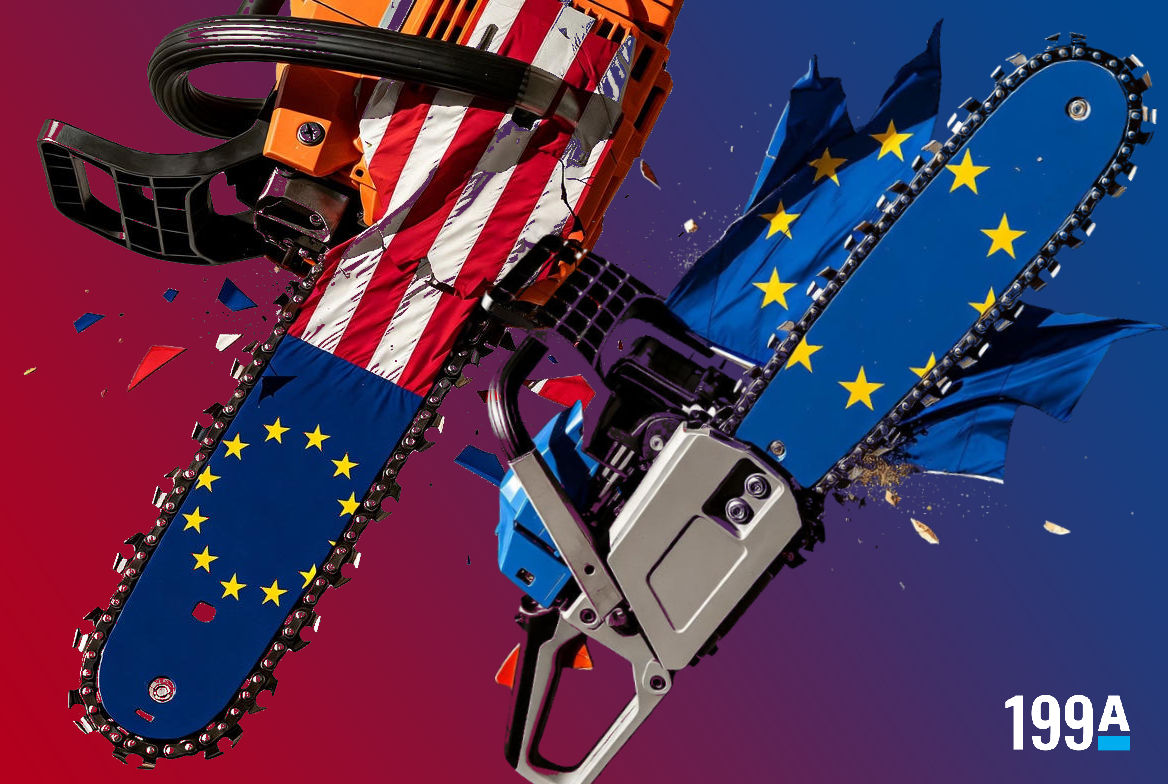
Elon Musk can wield the rhetorical chainsaw with virtuosity. Faced with law, it remains a noisy tool, not a weapon.