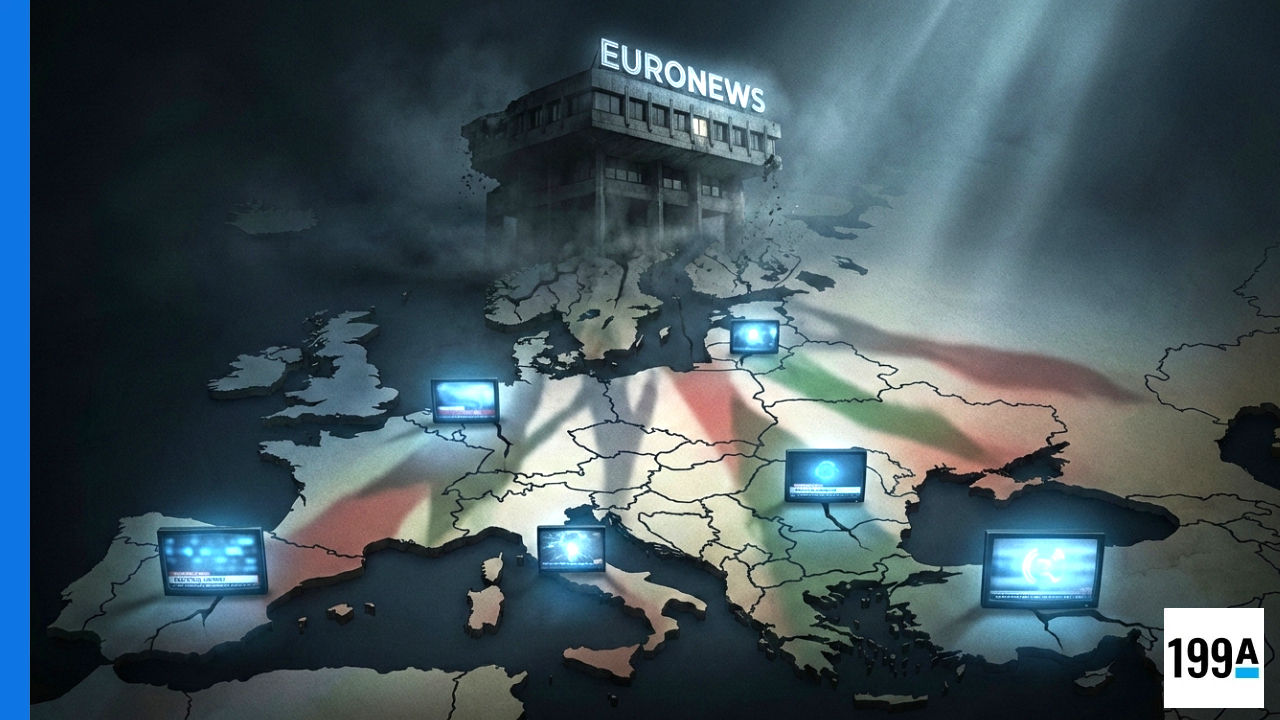
Euronews: from European compass to satellite of nationalist interests
Since its creation in 1993, Euronews had established itself as one of the few truly transnational pan-European news media: multilingual, cross-cutting in its approaches and designed to carry a European voice distinct from major American groups or national state agencies. This hybrid model (continuous news, linguistic plurality, anchoring in the European political project) was long presented as a virtuous exception in a fragmented media landscape.
This narrative has, however, been profoundly challenged over the past decade. Through a succession of acquisitions, capital restructuring and opaque strategic choices, Euronews has gradually shifted from an imperfect but identifiable European medium to an ambiguous informational object, exposed to foreign political influences and indirect propaganda logic. This shift is not accidental but part of a structured dynamic, where Hungarian entrism plays a central role, itself embedded in a broader transatlantic influence strategy.
A pan-European media under structural constraints
Founded in Lyon in the early 1990s, Euronews responded to a clear ambition: to offer a European alternative to global news channels, particularly American ones. Its operation was based on a consortium of public broadcasters, guaranteeing a diversity of national viewpoints and relative immunity from direct political pressure. But this architecture carried chronic fragilities. Weak profitability, dependence on subsidies, limited audience compared to Anglo-Saxon giants: Euronews remained structurally vulnerable. This economic fragility would become the breach through which external interests could gradually infiltrate.
The American entry: NBC as the first strategic pivot
The first significant turning point occurs in 2016–2017 with NBCUniversal's entry into Euronews' capital. Officially presented as a strategic partnership, the agreement allows NBC to take about 25% of the capital, inject funds and influence editorial direction through content exchanges and key appointments.
This rapprochement marks a first symbolic break: Euronews is no longer exclusively governed by European actors. While editorial independence is officially maintained, the balance is modified. The channel progressively adopts codes, formats and editorial priorities more compatible with a globalized market logic dominated by American standards.
This is not yet an ideological shift, but it is a dilution of the initial project. Euronews ceases to be a medium designed by and for Europe to become one actor among others in the global information economy.
The Alpac Capital takeover: a Portuguese facade, a political mechanism
The real breaking point occurs in 2022 with Euronews' takeover by Alpac Capital, a relatively discreet Portuguese investment fund. The operation is validated by French authorities and presented as a necessary financial rescue of a struggling media.
Very quickly, however, convergent journalistic investigations reveal a much more troubling reality. A significant portion of the funds mobilized for the acquisition comes from structures linked to the Hungarian state and Viktor Orbán's direct entourage. The financial arrangement, complex and deliberately fragmented, relies on Hungarian public funds, loans from communication agencies close to power, and close personal relationships between Alpac leaders and Hungarian political officials.
The decisive element is not only the origin of the capital, but the existence of internal documents explicitly referring to an objective of ideological reorientation of the media. There is talk of "mitigating left-wing biases" and repositioning Euronews in the European debate. This is no longer speculation: the political intention is formulated, assumed and documented.
Hungarian entrism as strategic proxy
Why Hungary? Because it constitutes today one of the most advanced laboratories for political capture of media in Europe. For more than a decade, the Orbán government has methodically restructured the national media landscape, concentrating newspapers, radio, television and digital platforms in the hands of oligarchs loyal to power.
This model does not rely on frontal censorship but on a combination of economic dependence, indirect pressure and progressive alignment of editorial lines. Transposed to the European scale, Euronews becomes a potential soft power tool: credible, multilingual, institutionally legitimate, and therefore infinitely more effective than an explicit propaganda medium.
Hungary acts here as a proxy. It allows broader interests (notably American conservatives or sovereignists) to insert themselves into the European informational space without appearing directly in the front line. The Portuguese veneer, the private structure and the complexity of the arrangement serve precisely to mask this reality.
Internal reorganizations and weak signals
Following the takeover, Euronews undergoes brutal restructuring. Hundreds of positions are eliminated, the headquarters is moved from Lyon to Brussels, and the newsroom is profoundly reorganized. Officially, this is strategic refocusing and economic adaptation. Unofficially, these upheavals weaken internal checks and balances and favor cultural recomposition of the newsroom.
No openly propagandist editorial line is imposed. It is not necessary. In this type of configuration, alignment occurs through self-censorship, through choice of subjects, through prioritization of information, through progressive normalization of certain narratives. This is precisely what makes the phenomenon difficult to objectify… and dangerous.
The editorial independence argument: a smokescreen
Euronews management continues to affirm the total independence of its newsroom. Formally, guarantees exist. But they become largely theoretical when:
- financing relies on indirect state funds,
- leaders maintain documented political ties,
- and the ideological objective has been explicitly formulated upstream of the acquisition.
The Hungarian experience demonstrates that explicit orders are not needed to transform a media: it suffices to control the material conditions of its existence.
A case study for Europe
The Euronews affair goes far beyond the fate of a news channel. It reveals a structural flaw in the European Union: the absence of robust democratic control mechanisms over acquisitions of strategic media. Where critical infrastructures or defense industries are subject to strict verification, information, though central in a democracy, remains surprisingly exposed.
Euronews has not become a crude propaganda organ. It is more subtle, more modern, more effective. It is a weakened, capturable medium, made compatible with illiberal narratives under the guise of pluralism and neutrality.
Euronews illustrates a worrying shift: that of a European medium conceived as a common information space toward an instrument of transnational political influence. The role of Hungary, as an assumed proxy of a broader ideological project, is central in this transformation.
The question is no longer whether Euronews is still independent in the formal sense. The real question is whether Europe is still capable of protecting its own informational spaces against sophisticated entryist strategies, legal in appearance, but profoundly corrosive for democratic debate.
Ignoring this signal would be a major political fault.
References and sources
- https://en.wikipedia.org/wiki/Euronews
- https://en.wikipedia.org/wiki/Alpac_Capital
- https://www.bgnes.com/politics/orban-linked-to-euronews-takeover
- https://www.rtl.be/actu/monde/france/la-hongrie-dorban-impliquee-dans-lachat-deuronews-selon-la-presse/2024-04-12/article/657996
- https://www.ifj.org/media-centre/news/detail/article/france-journalists-union-calls-for-the-opening-of-a-parliamentary-inquiry-into-euronews-takeover
- https://librentreprise.ma/2024/06/07/avec-le-rachat-deuronews-le-premier-ministre-hongrois-viktor-orban-etend-son-empire-mediatique/